
Introduction
Technology continues to reshape how businesses operate, how services are delivered, and how careers are built. Among all programming languages available today, Python has become one of the most trusted and widely adopted choices across industries.
Whether someone wants to build websites, automate repetitive work, analyze business data, create artificial intelligence applications, or enter software development, Python offers a strong starting point.
Choosing the right learning path matters as much as choosing the right programming language. A structured training environment helps learners understand concepts clearly, gain practical experience, and develop industry-ready capabilities.
For students, professionals, and career switchers looking to develop programming expertise, enrolling in a Python Course in Chandigarh can provide both technical understanding and practical exposure through guided learning and real projects.
This guide explains Python training, its importance, learning process, tools, industry applications, career opportunities, and future potential.
What is Python Course?
Definition and Overview
A Python course is a structured training program designed to teach learners how to write programs, build applications, automate tasks, and solve real-world problems using Python.
The learning process usually begins with programming fundamentals and gradually moves toward advanced concepts including:
Variables and data types
Loops and conditions
Functions
Object-oriented programming
File handling
APIs
Frameworks
Databases
Project development
Unlike many programming languages that feel complex for beginners, Python focuses on readability and simplicity.
Key Features
A well-designed Python training program generally includes:
Beginner to advanced learning path
Practical coding sessions
Real project implementation
Assignment-based learning
Debugging practice
Industry-focused curriculum
Portfolio development
Career preparation
How It Works
Python training typically follows a progressive learning structure.
Stage 1: Learn fundamentals
Example:
Creating a calculator using variables and operators.
Stage 2: Build logic
Example:
Writing a program that manages student records.
Stage 3: Develop applications
Example:
Building a simple e-commerce backend.
Stage 4: Work on projects
Example:
Creating automation tools or dashboards.
This approach transforms theory into practical capability.
Why is it Important?
Python continues to remain one of the most in-demand technical skills globally.
Benefits
Easy to learn for beginners
Supports multiple career paths
Strong community support
Fast development process
Large ecosystem of libraries
Business Advantages
Organizations use Python to:
Reduce manual work
Improve productivity
Analyze large datasets
Build scalable applications
Automate workflows
Marketing Relevance
Digital teams increasingly use Python for:
Data reporting
Campaign automation
SEO analysis
Customer segmentation
Performance tracking
Career Opportunities
Python opens opportunities in:
Software Development
Data Analytics
Artificial Intelligence
Machine Learning
Automation
Web Development
Real-World Applications
Examples include:
Building online platforms
Recommendation engines
Chatbots
Financial dashboards
Healthcare systems
Types of Python Course in Chandigarh
Beginner Python Training
Designed for complete beginners.
Topics:
Programming basics
Logic building
Python syntax
Example:
Creating a simple attendance application.
Python for Web Development
Focused on creating websites and web applications.
Topics:
Backend development
APIs
Databases
Framework integration
Example:
Building an online booking platform.
Python for Data Science
Ideal for data-focused learners.
Topics:
Data visualization
Analysis
Machine learning basics
Example:
Predicting business sales patterns.
Python for Automation
Focused on reducing repetitive work.
Topics:
Scripts
Workflow automation
System integration
Example:
Automating report generation.
Advanced Python Development
Suitable for experienced learners.
Topics:
Performance optimization
Architecture
Deployment
Example:
Building scalable software systems.
Step-by-Step Process
1. Understand Programming Fundamentals
Learn:
Syntax
Variables
Conditions
Loops
Best Practice:
Write code daily.
Common Mistake:
Skipping basics.
2. Practice Small Projects
Examples:
Calculator
Expense tracker
Quiz application
Best Practice:
Focus on completion.
Mistake:
Starting complex projects too early.
3. Learn Data Structures
Study:
Lists
Tuples
Dictionaries
Sets
Best Practice:
Use practical examples.
4. Work with Databases
Understand:
Data storage
Query execution
Application integration
Example:
Student management system.
5. Build Portfolio Projects
Examples:
Inventory system
Website backend
Analytics dashboard
6. Deploy and Test
Practice:
Debugging
Optimization
Deployment
Tools Used for Python Training
Free Tools
Visual Studio Code
Lightweight code editor.
Python IDE
Official development environment.
Jupyter Notebook
Popular for experiments and learning.
GitHub
Version control and portfolio management.
Paid Tools
PyCharm Professional
Advanced development features.
DataCamp
Interactive learning.
Cloud development environments
For deployment and testing.
Beginner-Friendly Tools
Replit
Browser-based coding.
Google Colab
Easy cloud execution.
Thonny
Simple interface for beginners.
Industry Sectors Using Python
E-commerce
Inventory management, recommendation systems, customer analytics.
Healthcare
Patient management and predictive analysis.
Education
Learning platforms and automated evaluation.
Real Estate
Property management tools and CRM systems.
Travel & Tourism
Booking engines and customer support automation.
IT & Software
Application development and testing.
Finance & Banking
Risk analysis and transaction processing.
Startups
Rapid product development.
Local Businesses
Business reporting and process automation.
Digital Marketing Agencies
SEO reporting, automation, and analytics.
Career Opportunities
Learning Python can create diverse professional paths.
Job Roles:
Python Developer
Web Developer
Data Analyst
Automation Engineer
AI Developer
Software Engineer
Required Skills:
Logic building
Problem solving
Database understanding
APIs
Framework knowledge
Salary Expectations:
Entry-level professionals may begin with competitive packages, while experienced developers often move into significantly higher salary ranges depending on specialization.
Growth Opportunities:
Team Lead
Technical Consultant
Product Engineer
Freelancing Opportunities:
Python professionals often work on:
Automation projects
Website development
Dashboard creation
Future Scope
Python continues to grow because of its adaptability.
Industry Demand:
Organizations continue hiring Python professionals across sectors.
AI Impact:
Artificial intelligence tools increasingly rely on Python ecosystems.
Future Trends:
Automation
Predictive analytics
Intelligent applications
Automation Influence:
Businesses prefer efficient systems over manual processes.
Long-Term Career Potential:
Python remains relevant due to continuous technological evolution and broad adoption.
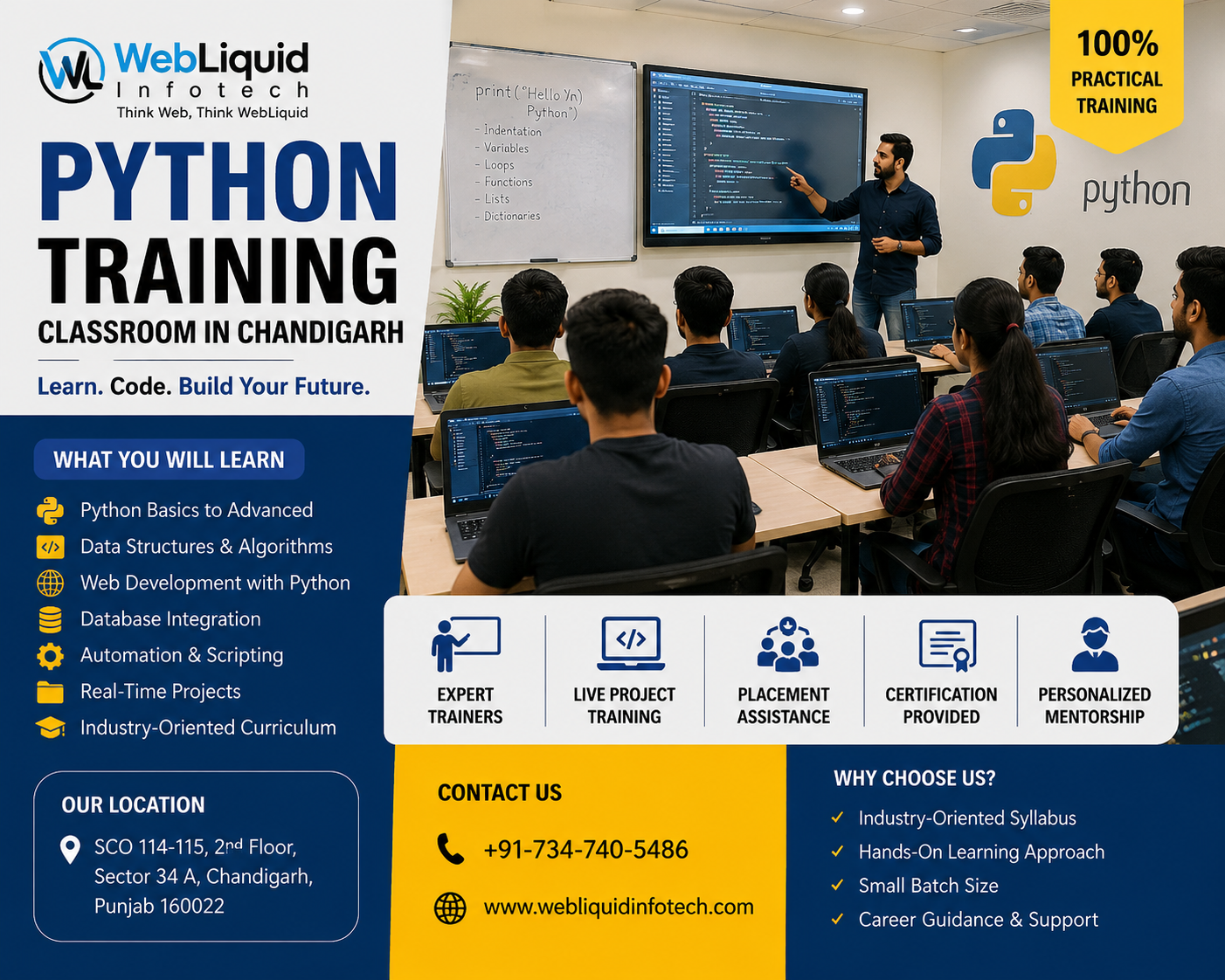
Learn Python Course in Chandigarh at WebLiquidinfotech Institute
Learning becomes more effective when theory and practice are combined.
WebLiquidinfotech Institute offers a structured environment designed to help learners understand concepts and apply them in practical scenarios.
Key learning highlights include:
Practical training sessions
Live project exposure
Guidance from industry experts
Placement assistance
Hands-on learning methodology
Industry-oriented curriculum
Address:
SCO 114-115, 2nd Floor, Sector 34 A, Chandigarh, Punjab 160022
Contact:
+91-734-740-5486
Website:
www.webliquidinfotech.com
The training approach focuses on helping learners build confidence through implementation instead of memorization.
Conclusion
Python continues to be one of the most valuable programming skills for modern careers and business growth. From automation and software development to analytics and AI applications, its practical use continues expanding across industries.
Choosing structured learning helps transform concepts into capability. Through practical experience, project-based learning, and industry exposure, students can build stronger foundations and prepare for future opportunities.
For anyone planning to enter technology or strengthen technical skills, a professionally guided Python Course in Chandigarh can become an effective starting point toward long-term growth.
FAQs
1. What is a Python course?
A Python course teaches programming concepts, application development, automation, and problem-solving using Python.
2. Who can join a Python course?
Students, graduates, professionals, business owners, and beginners can join.
3. How long does Python training usually take?
Most programs range from a few weeks to several months depending on depth and schedule.
4. Is Python difficult to learn?
Python is considered beginner-friendly due to its simple syntax.
5. Will I receive certification?
Many institutes provide completion certificates after training requirements are fulfilled.
6. What careers can I pursue after learning Python?
Roles include developer, analyst, automation engineer, and software professional.
7. Does Python have future demand?
Yes. Python remains widely used across software, AI, analytics, and automation.
8. Can I learn Python without coding experience?
Yes. Most beginner programs start from fundamentals.
9. Is practical training important?
Practical implementation helps strengthen concepts and improve employability.
10. Can Python help freelancers?
Yes. Freelancers use Python for websites, automation, APIs, and analytics projects.