
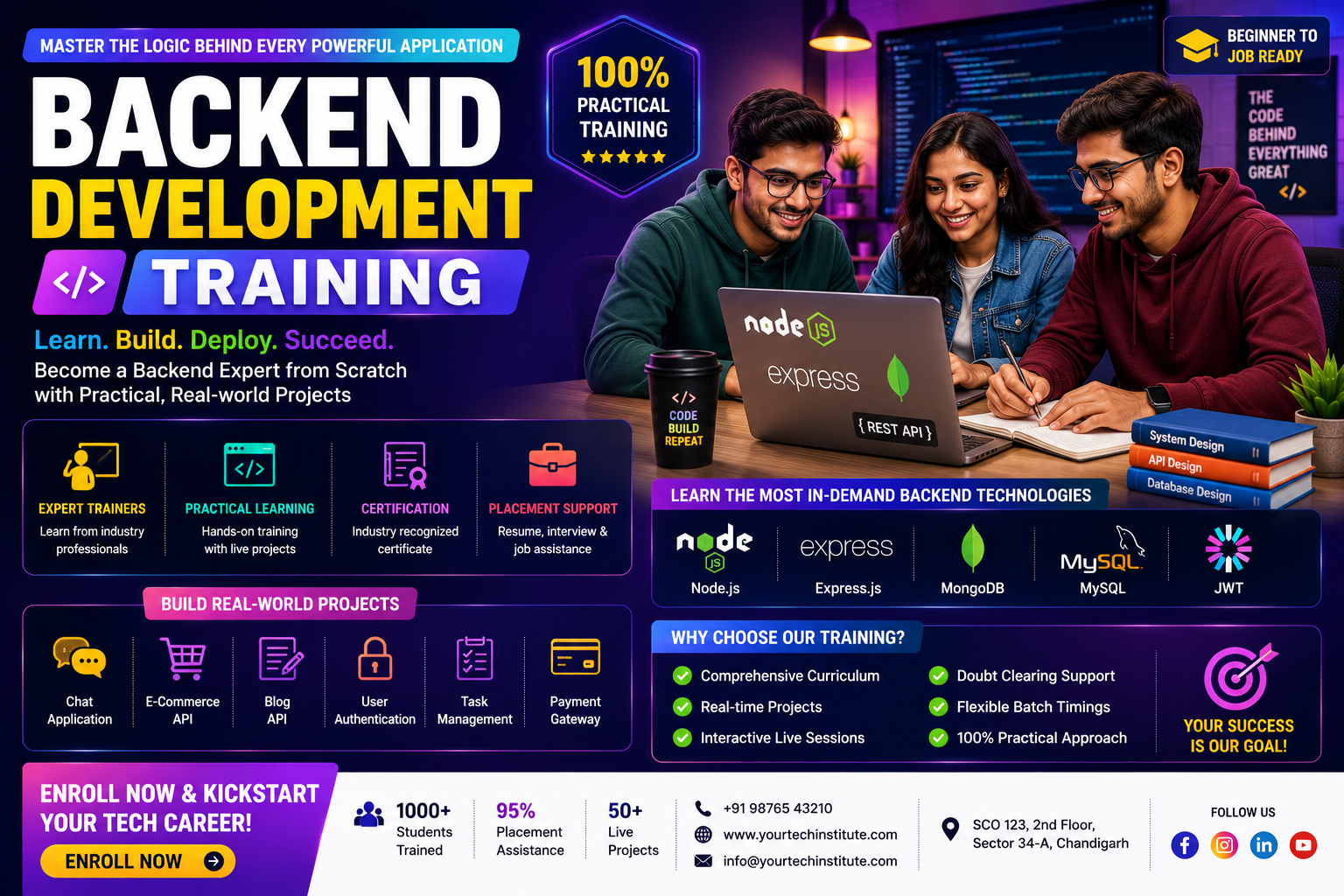
Introduction
Modern websites and applications do much more than display information. Today, businesses need platforms that can process data, manage users, handle transactions, and deliver smooth digital experiences.
Because of this growing digital transformation, backend development has become one of the most important skills in the technology industry.
Whenever users log in to a website, place an order, submit a form, or save information, backend systems work in the background to process those actions.
As a result, companies actively hire skilled backend developers who can build secure and scalable applications.
Many students want to start careers in software and web development. Meanwhile, working professionals are searching for technical skills that offer strong job opportunities and career growth.
However, beginners often feel confused about backend technologies and server-side programming.
Some learners struggle to understand APIs and databases. Others find server-side coding difficult in the beginning.
This is why structured backend development training becomes extremely valuable.
A professional course helps students understand coding concepts step by step through practical learning and real-world projects.
Webliquidinfotech Institute offers industry-oriented backend development training with practical implementation, live coding sessions, and beginner-friendly guidance. In addition, the institute focuses on helping students build job-ready technical skills through hands-on experience.
In this complete guide, you will learn:
- What backend development is
- Why backend development is important today
- Skills taught in backend training
- Career opportunities after training
- Benefits of practical learning
- How Webliquidinfotech Institute helps students succeed
What is Backend Development?
Backend development focuses on the server-side functionality of websites and web applications.
In simple words, backend systems manage the logic and operations that users cannot see directly.
Backend developers create systems that handle:
- User authentication
- Database management
- API communication
- Server-side operations
- Data processing
- Website functionality
Without backend development, websites cannot process requests or store information properly.
Moreover, backend systems help websites become secure, scalable, and functional.
How Backend Development Works
Whenever users interact with a website, backend systems process those requests in the background.
For example:
- Login forms verify user credentials
- E-commerce websites process payments
- Applications store user data
- APIs transfer information between systems
Backend developers write server-side code to manage these processes efficiently.
As a result, websites work smoothly and securely.
Technologies Used in Backend Development
Backend development uses different programming languages, frameworks, and databases.
Popular backend technologies include:
- Node.js
- Express.js
- MongoDB
- MySQL
- PHP
- Python
These technologies help developers create modern web applications and APIs.
Why Backend Development is Important Today
High Industry Demand
Modern businesses require secure and scalable applications.
Therefore, companies actively hire backend developers with strong server-side programming skills.
Industries hiring backend developers include:
- IT companies
- SaaS businesses
- E-commerce platforms
- Healthcare organizations
- Educational platforms
- Marketing agencies
- Startups
Consequently, backend development offers strong career opportunities.
Essential for Modern Applications
Backend systems manage the core functionality of websites and applications.
Without backend development, websites cannot:
- Store data
- Process payments
- Handle user accounts
- Manage databases
- Deliver dynamic content
Because of this, backend development is essential for modern digital platforms.
Excellent Career Growth
Backend developers are highly valuable in the technology industry.
Students can work as:
- Backend Developers
- API Developers
- Node.js Developers
- Full Stack Developers
- Software Engineers
These roles offer competitive salaries and long-term career growth.
Freelancing Opportunities
Many backend developers work independently with businesses worldwide.
For example, freelancers can provide:
- API development
- Backend system creation
- Database integration
- Server-side customization
- Website functionality improvements
Besides this, freelancing provides flexible remote work opportunities.
Skills Taught in Backend Development Training
A professional backend course teaches both technical and practical skills.
Therefore, students become industry-ready developers.
Programming Fundamentals
Students first understand programming basics such as:
- Variables and functions
- Conditions and loops
- Arrays and objects
- Logic building
- Problem-solving techniques
Strong programming foundations improve backend development skills.
Node.js Development
Node.js is one of the most popular backend technologies.
Students learn:
- Server creation
- Request handling
- Backend architecture
- Routing systems
- Server-side JavaScript
As a result, students can build scalable backend applications.
Express.js Framework
Express.js simplifies backend development with Node.js.
Students understand:
- Middleware
- API creation
- Routing systems
- Backend structure
- Request and response handling
Consequently, backend coding becomes more organized and efficient.
Database Management
Databases help websites store and manage information securely.
Students learn:
- MongoDB basics
- SQL fundamentals
- CRUD operations
- Database integration
- Data storage techniques
Database knowledge is essential for backend development.
API Development
APIs allow frontend and backend systems to communicate.
Students learn:
- REST APIs
- JSON responses
- API testing
- Request handling
- Third-party integrations
Modern web applications depend heavily on API communication.
Authentication and Security
Backend systems must remain secure and reliable.
Students understand:
- Login systems
- Password encryption
- JWT authentication
- User authorization
- Security best practices
Security knowledge improves professional backend development skills.
Server Management Basics
Backend developers often work with servers and hosting environments.
Students learn:
- Server configuration basics
- Deployment concepts
- Hosting fundamentals
- Environment management
These concepts improve technical understanding.
Live Project Development
Practical projects are an important part of backend training.
Students work on:
- API development projects
- Backend applications
- Database integration tasks
- Real-world coding exercises
This practical exposure improves confidence and technical understanding.
Why Practical Learning Matters in Backend Training
Backend development is a practical skill. Therefore, implementation matters more than theory alone.
Students improve faster through live coding practice and project development.
Practical learning helps students understand:
- Real-world workflows
- Backend architecture
- Database communication
- API integration
- Industry coding standards
Additionally, project-based learning improves job readiness.
Common Challenges Beginners Face
Many beginners feel confused while learning backend development.
However, proper guidance makes the learning process easier.
Understanding Server-Side Logic
Backend programming can seem technical initially.
However, step-by-step learning simplifies complex concepts.
Database Management Difficulties
Beginners often struggle to understand database relationships and queries.
Nevertheless, practical implementation improves understanding quickly.
API Development Challenges
APIs involve request handling and data communication.
Therefore, students need practical exercises to master API development.
How Webliquidinfotech Institute Helps Students Learn Backend Development
Choosing the right institute plays a major role in skill development.
Webliquidinfotech Institute focuses on practical learning and industry-oriented training.
Industry-Oriented Curriculum
The curriculum follows current industry requirements.
Students learn:
- Node.js
- Express.js
- Database management
- API development
- Backend architecture
- Authentication systems
- Server-side programming
- Project development
As a result, students gain complete backend development knowledge.
Beginner-Friendly Teaching
Many beginners hesitate before learning backend coding.
However, trainers explain concepts in simple and easy language.
Because of this, students feel more confident during training.
Practical Learning Approach
Students receive hands-on training through:
- Live coding sessions
- Interactive assignments
- API development projects
- Real-world implementation
- Database integration practice
This approach improves coding confidence and technical understanding.
Real-World Project Exposure
Project-based learning helps students understand professional workflows.
For example, students work on:
- Backend applications
- Authentication systems
- API integration projects
- Database-driven applications
Therefore, learners become more industry-ready.
Career-Focused Training
The institute also focuses on career preparation.
Students receive guidance for:
- Resume building
- Portfolio development
- Interview preparation
- Professional project presentation
These skills improve placement opportunities significantly.
Who Should Join Backend Development Training?
This course is suitable for learners from different educational and professional backgrounds.
Students and Freshers
Students interested in software and web development can build strong technical careers through backend training.
Working Professionals
Many professionals want to switch careers into the IT industry.
Therefore, backend development training becomes a valuable career upgrade option.
Frontend Developers
Frontend developers can expand their skills by learning server-side programming and backend systems.
Freelancers
Freelancers can offer services such as:
- API development
- Backend customization
- Database integration
- Website functionality improvements
- Server-side application development
As a result, freelancing opportunities increase significantly.
Benefits of Learning at Webliquidinfotech Institute
Strong Technical Skills
Students improve:
- Backend programming abilities
- API development knowledge
- Database management understanding
- Coding confidence
- Problem-solving skills
These skills are highly valuable in today’s IT industry.
Better Career Opportunities
Backend development skills create opportunities across multiple industries.
Consequently, students can apply for high-demand technical roles.
Practical Experience
Live projects improve:
- Technical understanding
- Portfolio quality
- Coding confidence
- Industry readiness
Practical exposure is essential for career growth.
Job Readiness
Students become familiar with:
- Professional coding workflows
- Team collaboration
- Real-world projects
- Client requirements
This improves interview preparation and workplace performance.
Career Opportunities After Course Completion
Students who complete backend development training can explore multiple career paths.
Backend Developer
Backend developers create server-side systems and manage website functionality.
Node.js Developer
Node.js developers build scalable applications using server-side JavaScript.
API Developer
API developers create communication systems between applications and platforms.
Full Stack Developer
Full stack developers handle both frontend and backend systems.
Freelance Backend Developer
Freelancers work independently with businesses and international clients.
Industries Hiring Backend Developers
Backend professionals are required in:
- IT companies
- SaaS businesses
- E-commerce platforms
- Educational institutions
- Healthcare organizations
- Startups
- Marketing agencies
Because of this demand, backend development offers strong long-term career growth.
Institute Details
Students interested in professional backend development training can connect with Webliquidinfotech Institute using the details below:
Address
SCO 114-115, 2nd Floor, Sector 34-A, Chandigarh, 160022
Phone Number
734-74O-5486
Website
The institute provides practical and industry-oriented training programs designed to help students build strong backend development and server-side programming skills.
Conclusion
Backend development has become one of the most valuable skills in today’s technology industry. Businesses across every sector need secure and scalable applications to manage data, users, and digital operations effectively.
Professional backend development training helps students learn server-side programming, API development, database management, authentication systems, and real-world project implementation through practical learning.
Moreover, backend development skills improve career opportunities because companies actively hire developers with strong technical expertise and practical coding experience.
Webliquidinfotech Institute helps students build strong backend programming foundations through practical learning, beginner-friendly teaching, live projects, and career-focused training.
Whether you are a student, freelancer, working professional, or aspiring developer, backend development can open doors to excellent career opportunities in the technology industry.
FAQs
1. What is backend development?
Backend development focuses on the server-side functionality of websites and applications, including databases, APIs, and application logic.
2. Can beginners learn backend development?
Yes. Beginners can learn backend development through structured training and practical projects.
3. Which technologies are taught in backend development training?
Students usually learn Node.js, Express.js, databases, API development, authentication systems, and server-side programming concepts.
4. Is backend development a good career option in 2026?
Yes. Backend development remains one of the most in-demand career fields with excellent job opportunities worldwide.
5. Does Webliquidinfotech Institute provide practical backend training?
Yes. The institute focuses on practical learning, live coding sessions, API projects, and industry-oriented assignments.
6. What career opportunities are available after completing backend development training?
Students can work as backend developers, Node.js developers, API developers, full stack developers, or freelance backend developers.